
Bass Metal Automates
Shear Machine
Operations
How Camex Robotics engineered a cobot tending solution for sheet metal processing — improving operator safety, cycle consistency, and production throughput.
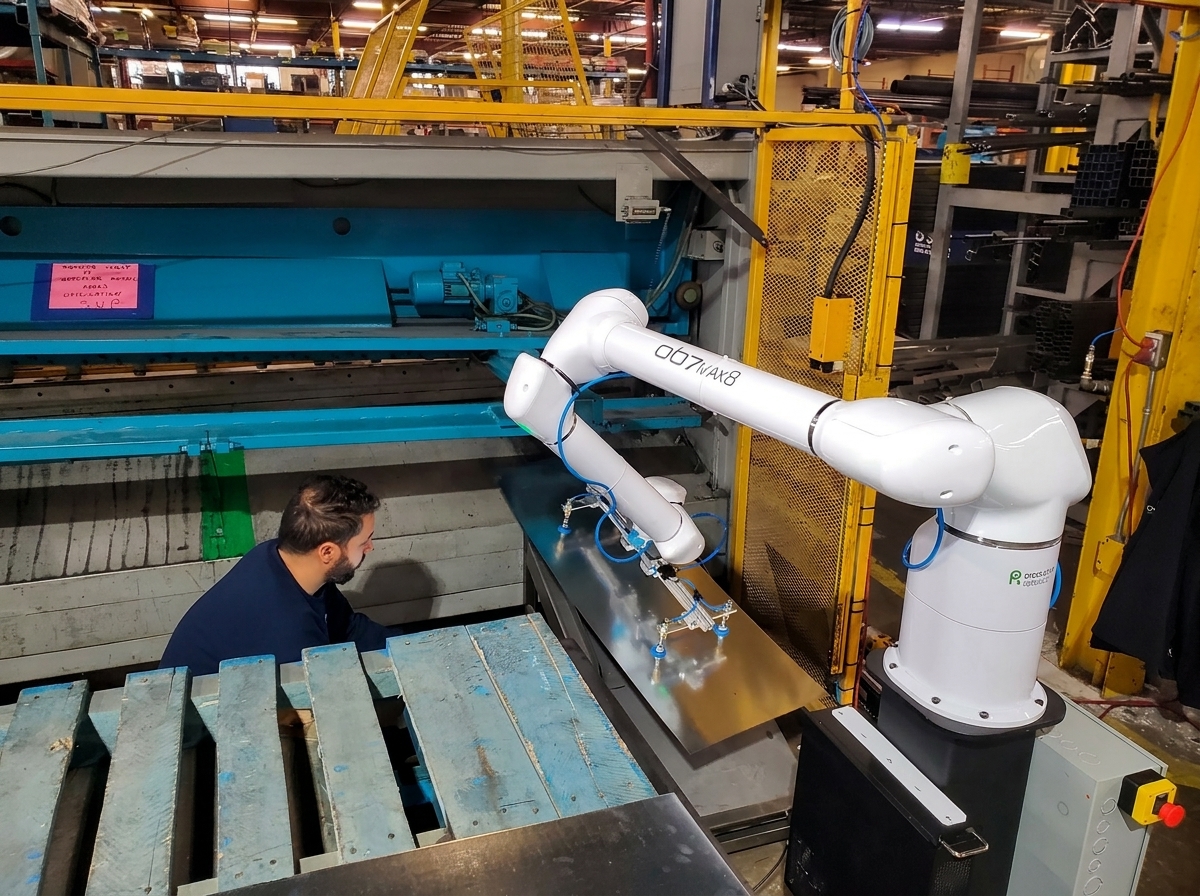
Bass Metal modernized its sheet metal processing operation by implementing a custom cobot tending system on its shear machine. The solution was engineered and integrated by Camex Robotics to automate part loading and unloading, improve operator safety, increase throughput, and deliver more consistent production flow.
The Challenge
Sheet metal shearing is a high-cycle process. At Bass Metal, the shear machine ran continuously to cut blanks for downstream fabrication — which meant an operator was stationed at the machine for most of the shift, manually loading stock and removing cut parts from the work zone.
The ergonomic cost was significant. Handlers were reaching repeatedly over the shear bed to position and retrieve material, exposing themselves to the fatigue and injury risk that comes with any high-repetition manual task near moving machinery. Beyond safety, the process was limited by human pace and stamina — output varied shift to shift depending on who was running the machine and how far into the shift they were.
Bass Metal needed a solution that would take the repetitive material handling off the operator's plate entirely, while fitting within their existing floor layout without a major facility reconfiguration.
The Solution
Camex Robotics designed and integrated a cobot tending cell around a Productive Robotics OB7 MAX 8 — a seven-axis collaborative robot arm purpose-built for machine tending applications. The OB7's unique geometry allows it to reach into confined spaces and reorient parts with a natural wrist motion, making it well suited for loading and unloading the shear bed without requiring the large clearance envelopes of traditional industrial robots.
The cobot was fitted with a custom vacuum gripper end-of-arm tooling package designed around Bass Metal's sheet sizes. The gripper picks sheets from an input stack, positions them precisely against the shear back gauge, triggers the cut, and removes the finished blank to an output stack — handling the full load-cut-unload cycle autonomously.
The system was integrated directly with the shear's existing controls. Camex engineered the I/O handshake between the cobot and the shear so the robot and machine operate in coordinated sequence, with built-in safety interlocks ensuring the shear cannot fire while the cobot arm is in the work zone. The operator remains present to manage stock replenishment and monitor production, free from the physical demands of the previous manual process.
The Results
Since deployment, the shear cell at Bass Metal runs at a consistent machine-rated cycle pace regardless of shift time or operator availability. The cobot does not slow down, does not fatigue, and executes the same load-unload sequence with the same positioning accuracy on every part.
Operator safety has measurably improved. The manual reach-and-retrieve motion that previously put workers in proximity to the shear blade zone has been eliminated entirely. The operator's role has shifted to material staging and quality oversight — higher-value tasks with significantly lower ergonomic risk.
The project demonstrated that cobot tending is a practical, non-disruptive solution for sheet metal environments where space is tight and traditional robotic cells would be difficult to justify. By working within the existing cell footprint and integrating with the shear's native controls, Camex delivered a functional automation upgrade without the cost and downtime of a full line rebuild.
Automate Your
Machine Tending
Tell us about your machine and production volumes. We'll assess your application and build you a real proposal — no commitment required.