
Zip Cable Automates
Cable Tray Welding
Production
How Camex Robotics engineered a dual-cobot welding system to bring consistency and speed to high-volume cable tray manufacturing.
Zip Cable transformed its cable tray welding process by implementing a custom-engineered robotic welding system, designed and built by Camex Robotics to improve weld consistency, increase throughput, and reduce manual labor.
The Challenge
Zip Cable manufactures cable trays at high volume — a product where dimensional accuracy and consistent weld quality are non-negotiable. Each tray goes through multiple weld passes along its length, with dozens of attachment points that must be positioned and fused precisely to meet structural requirements.
The manual welding process that had been in place was functional but difficult to scale. Skilled welders were spending the majority of their time on repetitive, fixture-loaded weld sequences — work that was both physically demanding and highly sensitive to operator-to-operator variation. As production volumes grew, maintaining consistent output quality while managing workforce availability became increasingly challenging.
Zip Cable needed a system that could handle the full weld sequence on cable tray sections reliably, shift after shift, without sacrificing the quality standards their customers expected.
The Solution
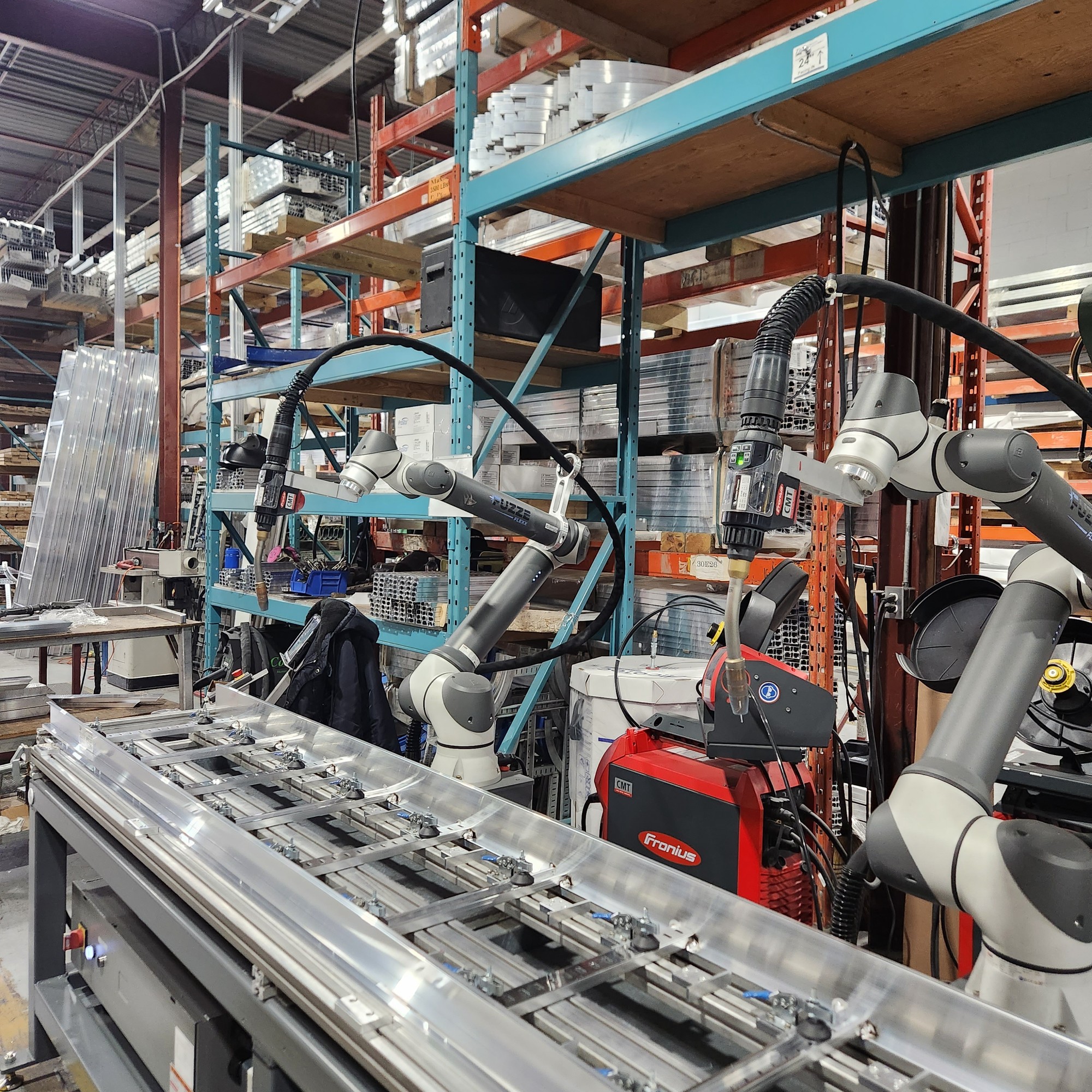
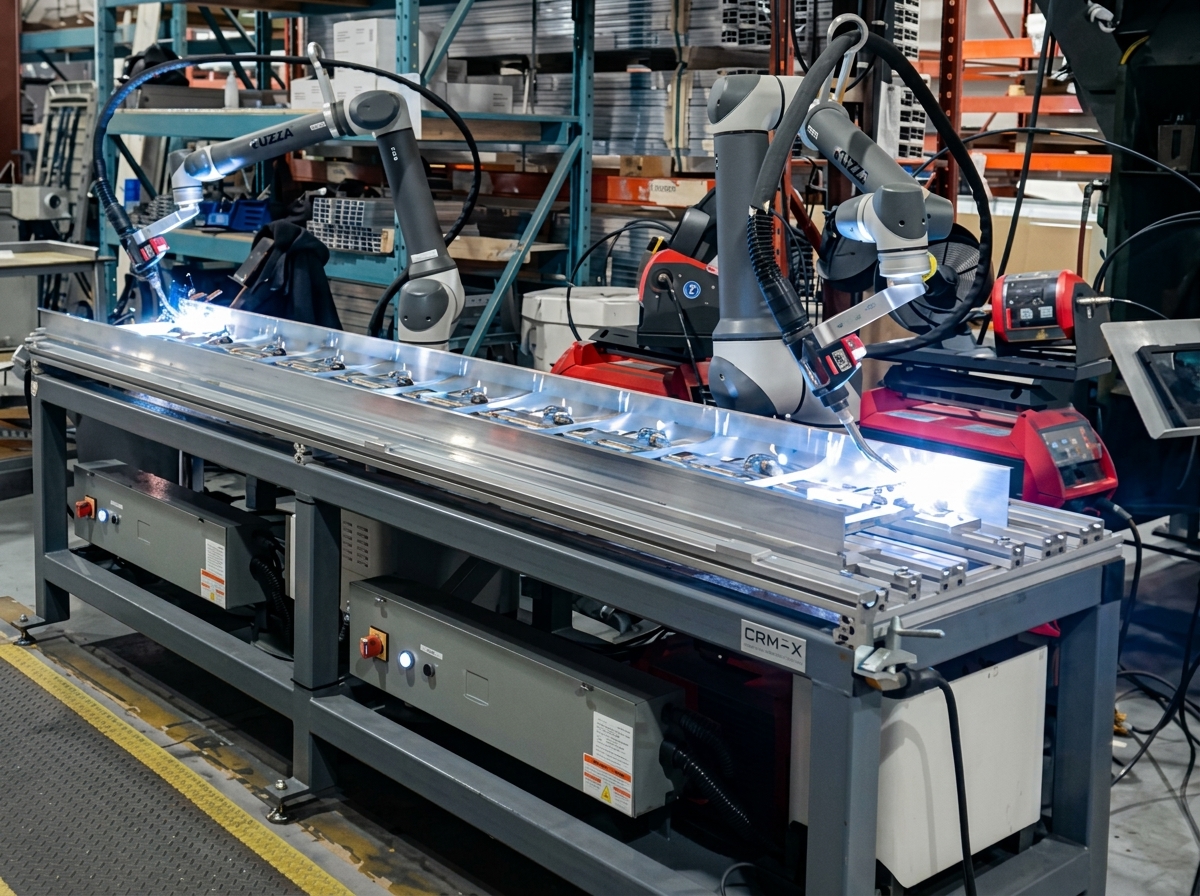
Camex Robotics engineered a dual-cobot welding cell purpose-built for Zip Cable's cable tray production. Two collaborative robot arms — each equipped with a Fronius CMT (Cold Metal Transfer) welding torch — were positioned on opposite sides of a custom linear fixture that holds the cable tray section in precise alignment throughout the entire weld cycle.
The Fronius CMT process was selected for its low heat input and spatter control, which are critical for achieving clean, consistent welds on the thin-gauge material used in cable tray construction. Running both arms simultaneously on different weld zones significantly reduced cycle time compared to a single-robot approach.
Camex handled the complete project scope — mechanical design of the fixture and cell, robot programming for all tray variants, integration of the Fronius welding equipment, and full commissioning at Zip Cable's facility. Operators load and unload trays; the cobots handle all welding autonomously.
The Results
Since the system went live, Zip Cable has seen a meaningful improvement in weld consistency across all cable tray sizes running through the automated cell. Every tray receives the same programmed weld path, eliminating the variability that had previously required downstream inspection and rework.
Throughput increased significantly as the dual-cobot setup processes weld sequences faster than a single operator working the same fixture. Production staff who were previously assigned to repetitive welding tasks have been redeployed to higher-value roles in quality control and material flow.
The system demonstrated how a well-designed cobot welding cell — built around the specific part geometry and production rhythm of the customer — can deliver both quality and capacity gains without a large-scale facility retrofit.
Let's Discuss Your
Welding Challenges
Tell us about your parts and production volumes. We'll assess your application and build you a real proposal — no commitment required.